
AI-Assisted Development: Faster Timelines
Discover how AI-assisted development transforms software timelines from months to weeks, allowing businesses to innovate faster and more efficiently.
AI-Assisted Development: Weeks, Not Years
Software projects have a reputation for running long. Six months becomes twelve, a year becomes two, budgets double, and features get cut.
That reputation exists for a reason. But it’s not the only way to build software anymore.
Why Traditional Development Takes So Long
The old process looks like this:
- Gather requirements (weeks)
- Design the system (weeks)
- Write the code (months)
- Test everything (weeks)
- Fix what broke (weeks)
- Deploy and hope
Each phase is manual. Each handoff introduces delay. Every miscommunication costs time.
And the biggest time sink? Writing code that’s been written a thousand times before.
Authentication systems, data validation, API integrations, admin dashboards, email notifications, file uploads. These aren’t novel problems. But every project rebuilds them from scratch because that’s how development has always worked.
What AI-Assisted Development Actually Means
We’re not talking about AI writing your entire application while you watch. That’s not real yet, and it might never be.
AI-assisted development means using AI to eliminate the repetitive parts so humans can focus on the parts that actually matter.
Here’s what that looks like in practice:
- Boilerplate code gets generated, not written: Database schemas, API endpoints, basic CRUD operations. AI generates them based on your requirements. We review and refine.
- Common patterns get reused intelligently: User authentication, payment processing, notification systems. AI knows the standard patterns and implements them. We customize for your specific needs.
- Testing gets automated from the start: AI writes the test cases alongside the code. Bugs get caught earlier. Rework happens less.
- Documentation writes itself: Code comments, API docs, user guides. AI generates the first draft. We clean it up and make it human.
The result? We spend our time on the 20% that’s unique to your business, not the 80% that’s generic infrastructure.
What This Means for Timeline
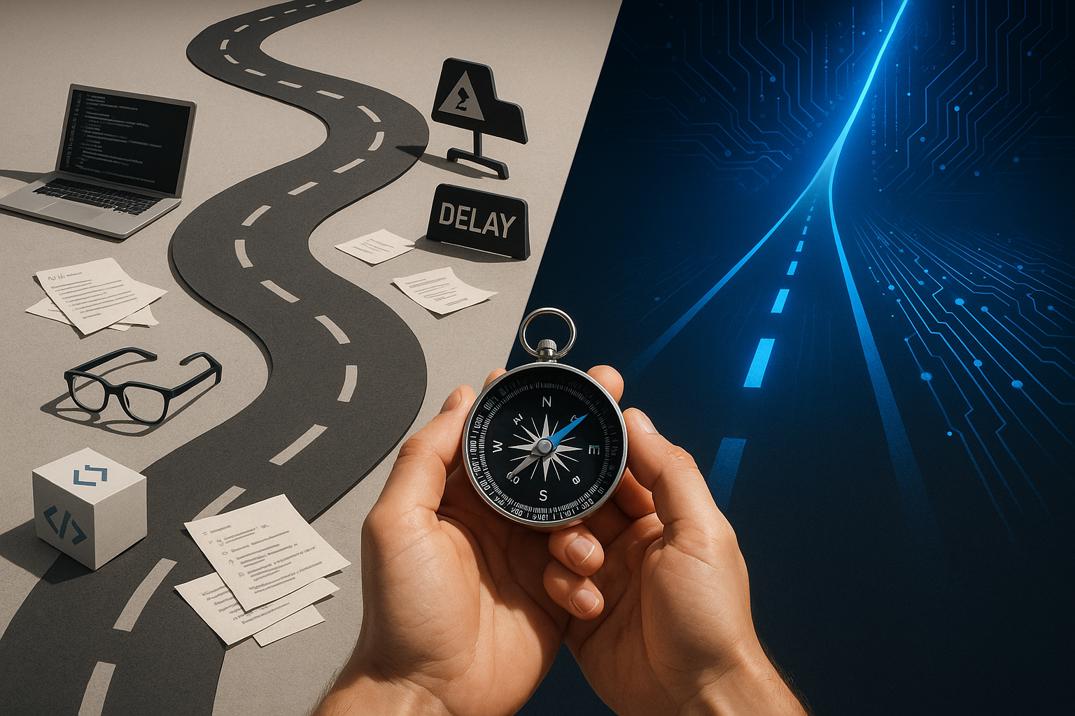 A traditional project that might take 9 to 12 months can now happen in 8 to 12 weeks.
That’s not hype. That’s what we’re seeing on real projects.
Example: Custom CRM for a consulting firm
Traditional estimate: 6 months, $120,000
AI-assisted timeline: 10 weeks, $65,000
Example: Inventory management system for a distributor
Traditional estimate: 12 months, $200,000
AI-assisted timeline: 14 weeks, $95,000
Example: Client portal for a healthcare provider
Traditional estimate: 8 months, $150,000
AI-assisted timeline: 9 weeks, $70,000
The pattern is consistent. Projects that used to take 6 to 12 months now take 8 to 16 weeks.
What Doesn’t Change
AI doesn’t eliminate the hard parts. It eliminates the tedious parts.
You still need to know what you’re building and why. You still need to make decisions about features, tradeoffs, and priorities. You still need to design the user experience.
The difference is we’re not spending weeks writing code that could be generated. We’re spending that time on the things that actually differentiate your business.
- Requirements still matter: If you don’t know what you need, AI can’t help you. Garbage in, garbage out. We still spend time upfront making sure we understand the problem.
- Design still matters: AI can generate code. It can’t generate good judgment about what users need or how a system should work. That’s still human work.
- Quality still matters: AI-generated code isn’t perfect. It needs review. It needs refinement. We’re developers, not supervisors. We’re just more productive.
The Real Advantage Isn’t Speed
Speed is nice. Getting to market in 10 weeks instead of 10 months is valuable.
But the real advantage is iteration.
When development is fast, you can try things. You can build a feature, test it with users, and refine it based on feedback. You can pivot when you learn something new.
When development is slow, you have to get it right the first time. You can’t afford to experiment. You’re locked into decisions you made months ago based on assumptions that might be wrong.
Fast development means you can learn while you build. That’s worth more than speed alone.
What It Costs
AI-assisted development isn’t free. But it’s a lot cheaper than traditional development.
Here’s a realistic range:
- Small project (8 to 10 weeks): $25,000 to $75,000
- Medium project (10 to 14 weeks): $75,000 to $120,000
- Large project (14 to 20 weeks): $120,000 to $200,000
Compare that to traditional development at the same scope:
- Small project (4 to 6 months): $80,000 to $150,000
- Medium project (6 to 9 months): $150,000 to $250,000
- Large project (9 to 18 months): $250,000 to $500,000
The cost per hour is similar. The difference is how many hours it takes and how soon your project can launch.
When This Makes Sense
AI-assisted development works best for:
- Custom internal tools that replace SaaS
- Client portals and dashboards
- Workflow automation systems
- Data management and reporting tools
- API integrations and middleware
It works less well for:
- Highly novel technical problems with no existing patterns
- Projects where the requirements are completely unclear
- Systems that require specialized domain expertise to code
If you’re building something that’s 80% standard patterns and 20% unique logic, AI-assisted development will save you months.
If you’re building something truly unprecedented, it’ll still help, but the advantage is smaller.
What You Should Expect
We’re not promising miracles. We’re promising competence at a faster pace.
Here’s what a typical project timeline looks like:
- Week 1 to 2: Requirements and design: We figure out what you need. We map the workflows. We design the data model.
- Week 3 to 8: Core development: We build the system using AI to accelerate the repetitive parts. You get weekly demos. We adjust based on feedback.
- Week 9 to 10: Testing and refinement: We test with real users. We fix issues. We optimize performance. We prepare for launch.
- Week 11 to 12: Deployment and training: We deploy to production. We train your team. We hand over documentation.
After that, you own it. We can maintain it if you want. Or you can take it in house. It’s yours.
The Bottom Line
 Software doesn’t have to take forever anymore. Not if you’re willing to let AI handle the boring parts.
The projects that used to take a year can happen in a quarter. The budgets that used to require six figures can happen for half that.
But the real shift isn’t speed or cost. It’s confidence.
When you can build in weeks instead of months, you can make decisions faster. You can test ideas without betting the company. You can adapt to what you learn.
That’s what AI-assisted development actually gives you. Not just faster code. Faster learning.
If you’ve been putting off a custom build because the timeline felt too long or the cost felt too high, it might be time to reconsider.
The math changed. And it’s not changing back.